
PHP scripting
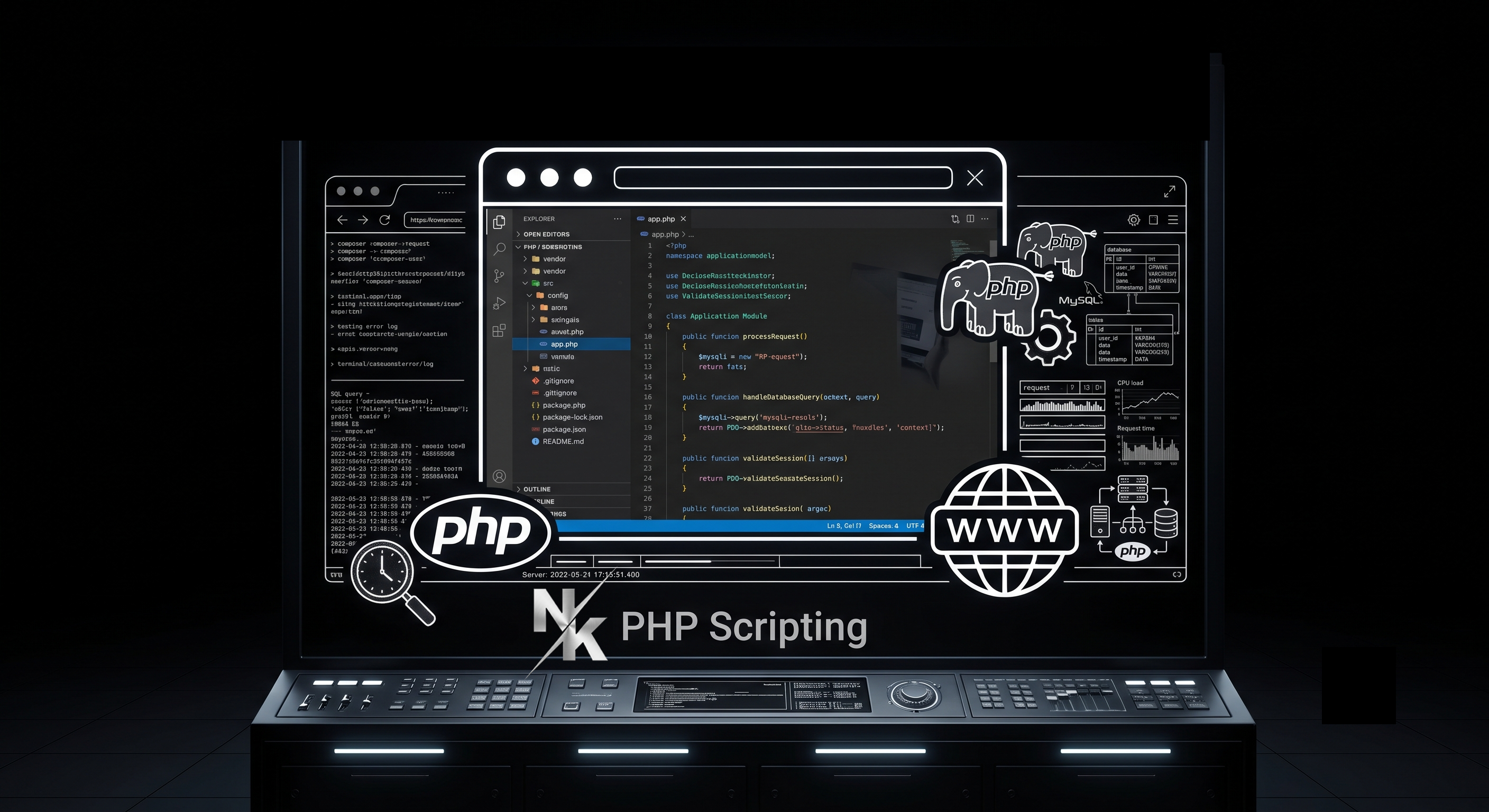
PHP (Hypertext Preprocessor) is a widely used open-source server-side scripting language designed for web development. It is embedded within HTML and executes on the server to generate dynamic web pages and applications.
PHP Syntax:
PHP scripts are enclosed within tags and include variables, operators, comments, data types, and expressions used to build application logic.
Variables and Data Types:
PHP supports integers, floats, strings, booleans, arrays, objects, NULL, and resources. Variables begin with the $ symbol and are dynamically typed.
Control Structures:
Conditional statements such as if, else, switch, and looping constructs including for, while, do-while, and foreach enable decision-making and repetition.
Functions:
Functions organize reusable code. PHP supports built-in functions and user-defined functions with parameters, return values, and scope.
Forms and User Input:
PHP processes HTML forms using GET and POST methods, validates input, sanitizes data, and handles file uploads securely.
Database Connectivity:
PHP commonly interacts with MySQL using PDO or MySQLi to perform CRUD operations, execute queries, and manage transactions securely with prepared statements.
Sessions and Cookies:
Sessions maintain user state on the server, while cookies store small amounts of data in the user’s browser for personalization and authentication.
Error Handling and Security:
PHP provides exception handling, error reporting, input validation, password hashing, protection against SQL injection, XSS, and CSRF attacks to improve application security.
Object-Oriented PHP:
PHP supports classes, objects, inheritance, polymorphism, interfaces, traits, encapsulation, and namespaces for scalable application development.
File Handling:
PHP can create, read, write, append, upload, and delete files and directories on the server while managing permissions securely.
Best Practices:
Effective PHP development includes writing modular code, following coding standards, documenting code, using version control, optimizing performance, and regularly updating dependencies.